TL;DR: Many digital signage platforms run on hardware whose firmware is controlled by the device manufacturer, not the signage vendor. On those devices, the signage vendor can't vouch for everything running on the screen. The XCPE botnet, which Google exposed in November 2026, showed how real that risk is: a backdoor built into factory firmware infected more than 1.3 million set-top boxes, and Google also found it on other Android devices, including digital signage devices. Skykit avoids the problem by controlling the firmware on its media players, including Skykit OS, its hardened Android-based operating system, and locking every Skykit media player down to run only Skykit software and admin-approved apps.
{{divider}}
What's the security risk with off-the-shelf signage players?
The biggest risk is firmware the signage vendor doesn't control. Digital signage runs on media players and system-on-chip (SoC) displays from a long list of device manufacturers, many of them small, low-cost makers competing to meet the performance, price, and display requirements of signage installations. On those devices, the manufacturer decides what software ships and when it gets updated.
Factory firmware can include apps no one asked for
Off-the-shelf devices often come with apps and software libraries the manufacturer preinstalled. Some of those apps contact outside servers, and neither the signage vendor nor the customer can see what they send or why.
I saw this firsthand with a customer that was still running a legacy SoC display from another vendor on that vendor's stock firmware, and the display was making unexplained calls to a server in China for time updates. Because the manufacturer controlled the firmware, there was no way to remove it. That's why Skykit supports only approved Android devices managed by Skykit's Device Management solution, Control. Nearly all of them run firmware Skykit builds and signs with the manufacturer.
Open devices let anyone install anything
If the device lets users install apps, anyone with access to the screen can add software, including malware. On a network-connected screen in a lobby, a break room, or a factory floor, that's an open door into the corporate network.
Is the factory firmware risk real?
Yes. In a report published November 2, 2026, Google's Threat Intelligence Group exposed XCPE, a backdoor that Android device maker Videostrong built into the factory firmware of devices it supplied across many models and brands. It enrolled more than 1.3 million set-top boxes into a botnet, and Google also found it on other Android devices, including digital signage. Google and its partners have since taken down the servers that controlled the botnet, and Google has banned Videostrong from building certified Android devices.
Because XCPE lived in the firmware, it ran with full system privileges, reinstalled itself if deleted, and took remote commands. Its operators used infected devices for ad fraud, resold their internet connections, captured live screenshots, and pulled data off them. XCPE also got past Google's own certification testing by loading its malicious code after the device's first boot. Certification alone can't catch everything, which is why it matters to know what's running on every device.
Skykit Engineering found no trace of XCPE on Skykit devices
After Google published its findings, Skykit Engineering checked for the indicators of compromise in the report in two ways. On the bench, engineers inspected four current Skykit media player models and a Philips display. They looked for the backdoor's apps and components, searched every firmware file on each device for its command-and-control domains and server addresses, compared every installed app against the malware fingerprints Google published, and watched for connections to the attackers' servers. Across the fleet, they searched every weekly app report from devices running Skykit Control back to March 2024, covering more than 80,000 devices and the period Google has documented. They found no trace of XCPE anywhere. None of the Skykit models tested are made by Videostrong.
{{divider}}
How does Skykit OS protect signage devices?
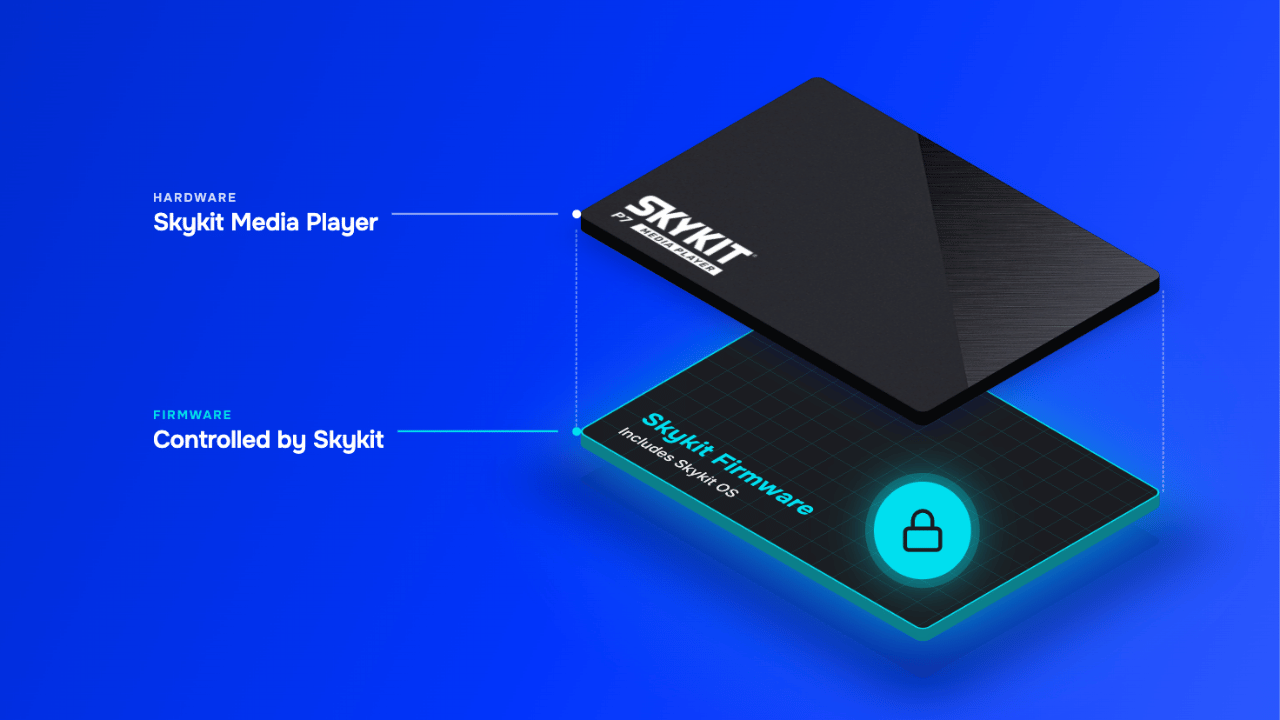
Skykit OS, Skykit's own operating system for digital signage, protects devices by giving Skykit control of everything that runs on them. Skykit OS ships as part of Skykit firmware, the complete software package installed on Skykit media players and on Hisense and Bluefin displays. It's built on an Android foundation, but Skykit hardens it, strips it down, and locks it for commercial signage.
Skykit controls and signs its own firmware
Skykit media players don't run a manufacturer's stock firmware. Skykit engineers build and maintain the firmware together with each hardware manufacturer, who follows Skykit's instructions on what goes into every build. Every build is signed with Skykit-specific platform keys, which Skykit maintains separately for each manufacturer partner, and carries a Skykit build ID. SoC displays from Hisense and Bluefin run Skykit firmware too. A small number of Sony and Philips displays in the fleet run their manufacturer's own firmware and are managed through Skykit Control like every other device.
Only essential software ships
Skykit has the manufacturer remove every package that can be removed, then tests and iterates on each build to keep the footprint as small as possible. Only the software required to run the operating system and render content is included, which shrinks the attack surface and removes apps that could contact unknown servers. Every year, an independent third-party firm penetration-tests several devices across the Skykit lineup, along with their web interfaces and the Skykit cloud platform.
Devices are locked in kiosk mode
With Skykit Control, devices run in a system-level kiosk mode. Users at the screen can't install apps or exit the Skykit player. Any apps allowed on a device, along with settings like volume and peripherals, are managed centrally in Skykit Control by users with the right permissions.
Skykit can see what's on every device
Every device running Skykit Control reports its full list of installed apps, including system apps, once a week. When Google published the XCPE report, that visibility let Skykit check every device running Skykit Control within days.
Dashboards render on the device, not in a vendor's cloud
Many signage platforms render dashboards in the cloud and send screenshots to the screen. Skykit renders dashboards live on the device. Dashboard Connections authenticate on the media player with credentials pulled from Skykit's cloud keystore at the time of authentication. Credentials are not retained on the device.
Skykit can update the browser when providers change
When dashboard providers like Power BI drop support for older browsers, dashboards on manufacturer-controlled devices can stop working until the manufacturer ships an update. On devices running Skykit firmware, Skykit can update the browser itself, so dashboards keep running.
{{divider}}
What should IT teams ask their signage vendor?
IT teams should ask who controls the firmware, and what the vendor can see and change on every device. These six questions show whether a signage vendor can answer for its own screens:
- Who builds and signs the firmware on your players? If the answer is the device manufacturer, the vendor can't vouch for what's running on your screens.
- Can you see every app installed on every device? A vendor without a fleet-wide app inventory can't check for threats like XCPE when they're reported.
- Can end users install apps or exit the signage player? Screens should be locked to the signage software, with any additional apps approved and managed centrally by authorized admins.
- Where are dashboards rendered, and how are dashboard credentials handled? Dashboards rendered on the device don't pass through a vendor's screenshot service, and dashboard credentials shouldn't be stored on the screen.
- How fast can you update the browser when a dashboard provider changes? If the vendor depends on the manufacturer for updates, your dashboards depend on them too.
- Does an independent firm pen-test the devices and cloud platform? Regular third-party testing of the devices, their web interfaces, and the cloud platform shows the vendor's security holds up under outside scrutiny.
{{divider}}
Key takeaways
- On most off-the-shelf signage players, the device manufacturer controls the firmware, so the signage vendor can't vouch for everything running on the screen.
- The XCPE botnet put a backdoor in factory firmware on more than 1.3 million devices, including digital signage, and got past Google's certification testing.
- Skykit Engineering checked current media player models and more than 80,000 devices across the fleet, and found no trace of XCPE.
- Skykit controls the firmware on its media players, ships only essential software, locks devices in kiosk mode, and sees every app on every device running Skykit Device Management (Control).
Learn more about how Skykit protects your screens and data in the Skykit Trust Center.