.svg)

Florian Rotberg, Managing Director of invidis (and now Sixteen:Nine), published a piece last week that I think everyone in our industry should read: "Market Shakeout: Why Generic MDM Falls Short in Digital Signage Recovery."
His core argument is right. When integrators fail and screens go dark, the instinct to rip and replace hardware is expensive and usually unnecessary. The real gap is a missing orchestration layer — purpose-built Mobile Device Management (MDM) that understands signage, not just endpoints. Generic IT device management tools like Hexnode or TeamViewer can tell you a device is online, but they can't tell you what's actually on the screen.
I agree with all of that. But I want to push the argument one step further.
Even purpose-built device management has an accountability gap
Rotberg identifies the right symptoms: operators need proof-of-play, display-level control, and support for heterogeneous hardware fleets. Purpose-built device management platforms solve these problems better than generic MDM. No argument there.
But here's what I've seen play out repeatedly across enterprise deployments: even purpose-built device management hits a wall when it doesn't fully integrate and control the hardware underneath.
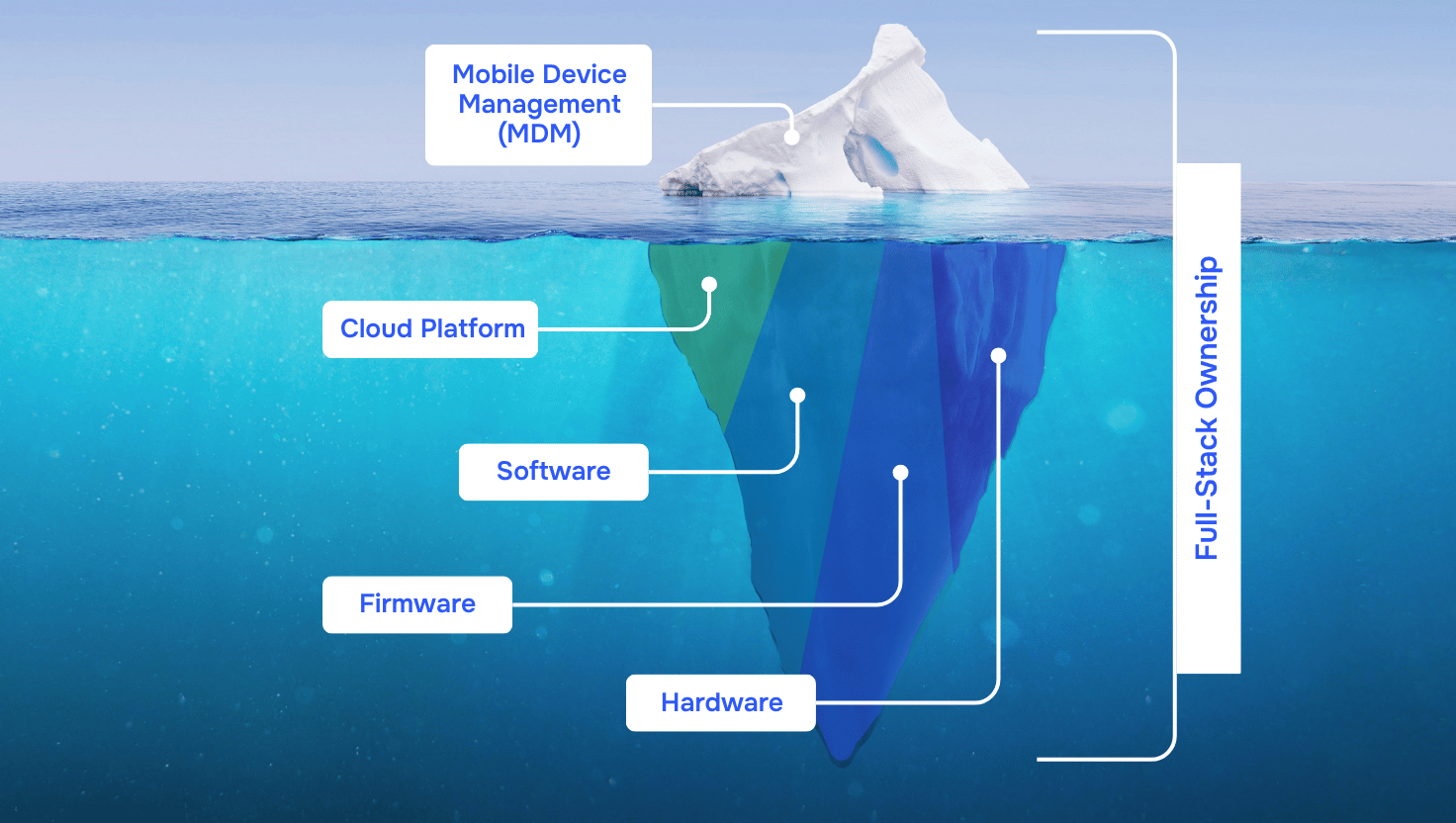
When you rely strictly on a software-only layer over an unpatched, legacy third-party OS, you run into a long-term accountability ceiling. While software can "get the lights back on" in an emergency, it cannot rewrite deep firmware bugs or fix aging hardware failures. For inherited fleets, software adoption is the emergency tourniquet—not the permanent cure.
If your device management platform is software-only, sitting on top of third-party hardware running third-party firmware, you've still got a finger-pointing problem. The device management vendor blames the media player manufacturer. The media player manufacturer blames the OS. The OS vendor blames the network. Meanwhile, screens stay dark.
This is the accountability gap that the article identifies at the device management level — but it exists at the signage-specific level too, just one layer deeper.
Full-stack control is the actual answer
At Skykit, we made a deliberate architectural decision years ago: control every layer. Our hardware. Our firmware. Our edge software. Our cloud platform. When a screen goes dark, we don't coordinate between vendors. We own the problem from cloud to firmware, and we fix it. One accountable partner, as enterprise buyers tend to demand.
This isn't just a support convenience. It has direct implications for the recovery scenarios Rotberg describes:
→ Security. When you control the firmware, you control the update governance. You can harden the device at a level that no software-only platform can reach. SOC 2 Type 2 compliance means something different when it covers the entire stack versus just the content layer.
→ Remote recovery. When you own the firmware layer, and control the OTA endpoint, you can remotely rebuild a device without dispatching a technician. Not just push new content — actually restore a player to a known-good state. That's the difference between a support ticket-based remote recovery vs a costly on-site intervention.
→ Proof of performance. Proof-of-play is table stakes. But when you control the full stack, you can validate not just what content was scheduled, but what was actually rendered— at what resolution, with what uptime, down to the individual frame. That's the level of accountability that ad networks and programmatic DOOH buyers require.
"Rip and replace" isn't always wrong. It depends on what you're replacing.
The article makes a strong case against unnecessary hardware replacement. I agree that functional displays and media players shouldn't be discarded just because the software layer failed. Purpose-built device management can absolutely extend the life of existing fleets.
But there's a nuance worth adding: sometimes the hardware itself is the vulnerability. Aging players running unpatched firmware, devices with no remote recovery capability, hardware from manufacturers who have stopped media player updates— these aren't just management challenges. They're security liabilities and operational time bombs.
The right approach isn't "never replace" or "always replace." It's assessing each media player and display in the fleet, extending what's viable, and replacing what's not. That’s how Skykit approaches fleet migrations.
The category isn't just device management
Rotberg calls for "a distinct category of solutions: purpose-built device management platforms." I'd refine that framing. What enterprises actually need is a purpose-built infrastructure platform — one that treats digital signage as what it's become: a critical enterprise system with the same expectations around security, uptime, and accountability as any other production infrastructure.
Device management is a necessary component of that platform. But it's not the platform itself.
The companies that will win the recovery scenarios playing out across North America right now aren't just the ones that can adopt existing fleets. They're the ones that can adopt them, secure them, prove performance on them, and — when necessary — replace them with hardware they fully control. That's the complete answer.
{{cta}}

See What Full-Stack Control Actually Looks Like
Skykit is an enterprise digital signage platform with full-stack control across hardware, firmware, and cloud — and SOC 2 Type 2 compliant. If you're navigating a fleet migration or evaluating your current platform's accountability gaps, we'd like to show you the difference.









.svg)


